Designing an e-SAF plant for the energy system of tomorrow

Building a new industry means making decisions today that will shape how it operates for decades. For Norsk e-Fuel, one of the most important questions is: How do we build an e-SAF plant that works with the future energy system, rather than against it?

Matching High Energy Demand to Variable Renewable Supply

e-SAF production requires large amounts of electricity. At the same time, Europe's energy system is rapidly shifting towards renewable power. While renewable electricity has the potential to provide abundant, low-cost energy, its availability is inherently variable. Future industrial consumers will therefore need to adapt when and how they use electricity.

Grid Stability Through Flexible Plant Operation

Unlike many other electricity-intensive industries, e-SAF production is well positioned to support this transition. Its most power intensive processes can operate with a high degree of flexibility, increasing output when renewable electricity is abundant and scaling back during grid congestion. This reduces production costs, eases pressure on the electricity grid, and supports the integration of additional renewable generation.

For Norsk e-Fuel, flexibility is a core design principle. Future e-SAF plants should become active participants in the energy system while remaining efficient, reliable, and fully compliant with the evolving EU regulatory framework. The challenge lies in identifying where flexibility creates the greatest value without compromising plant performance or fuel production.

A Time-Resolved Model of the Complete e-SAF Production Pipeline

To answer this question, Norsk e-Fuel partnered with Energynautics to develop a time resolved techno-economic optimization model covering the entire production process.

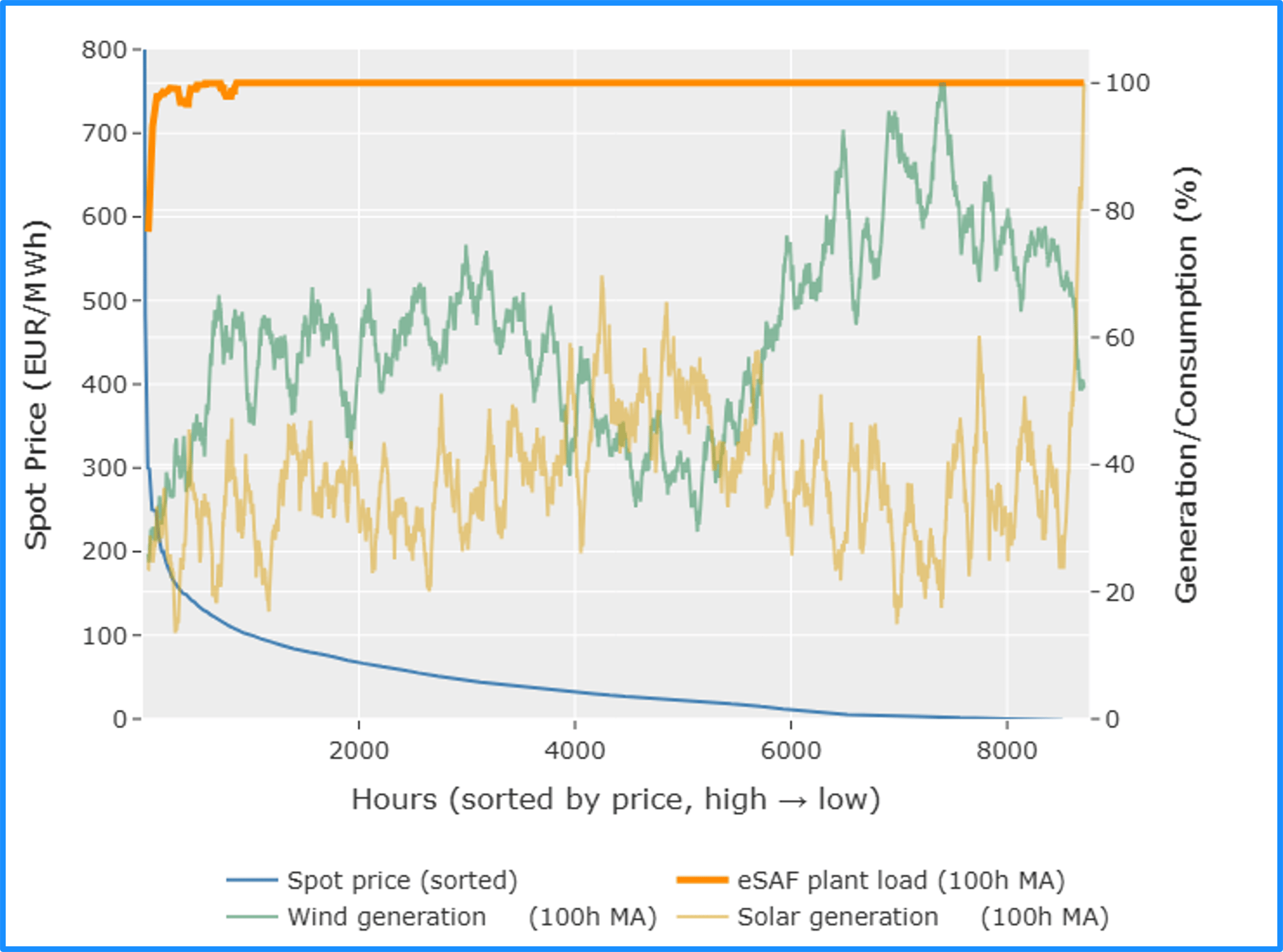
Baseload operation

Baseload operation

Both plants operate in the same location, have access to abundant wind power, and produce the same amount of fuel.

In baseload operation, the plant operates at a steady load, regardless of how much renewable electricity is available, leading to predictable and continuous operation.

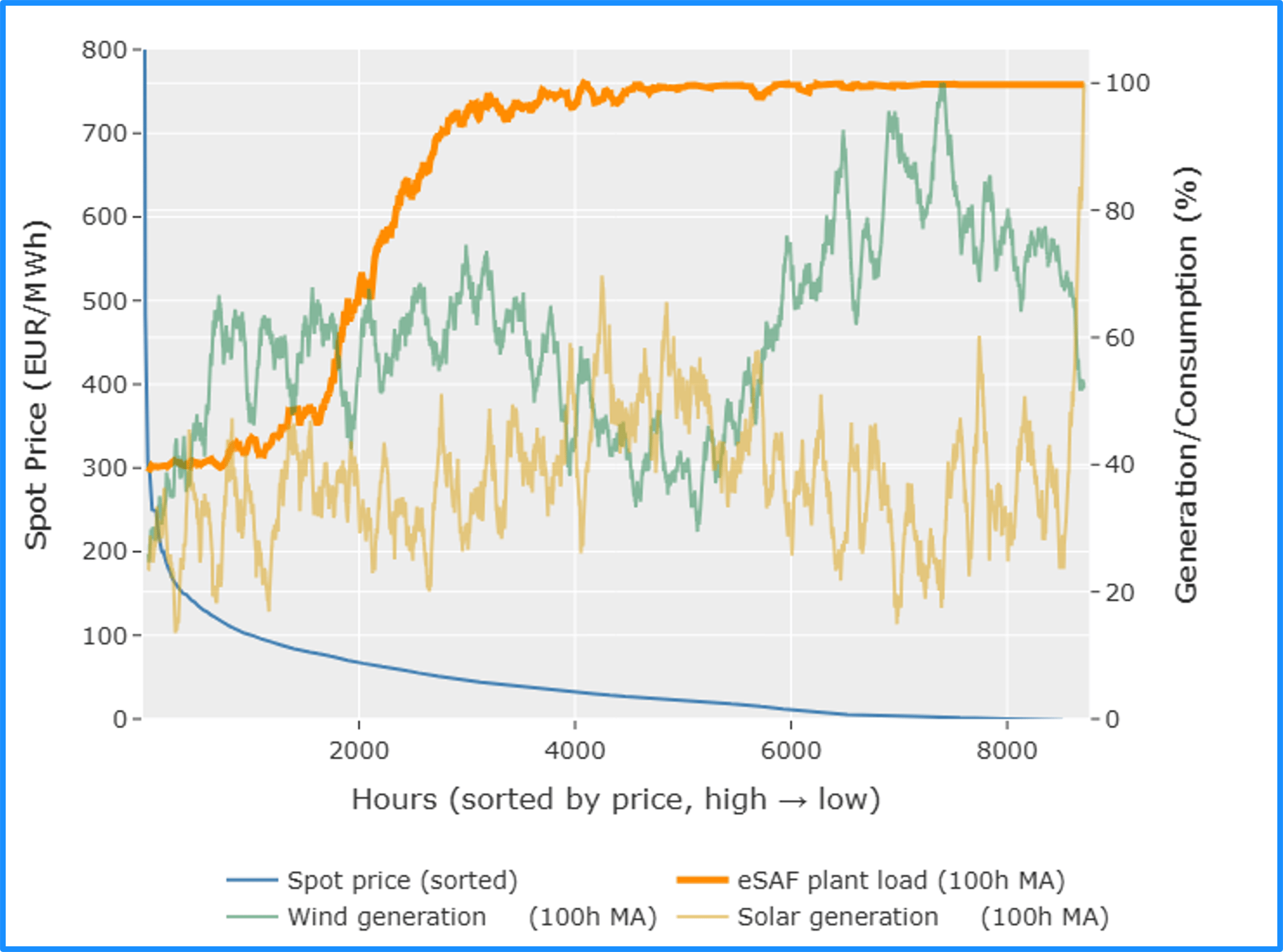
Flexible operation

Flexible operation

Both plants operate in the same location, have access to abundant wind power, and produce the same amount of fuel.

In flexible operation, the plant increases its production when renewable electricity is abundant and reduces it when availability is lower.

Energynautics developed a model that maps the complete e-SAF production pipeline, tracing the flow of electricity, water, carbon dioxide, hydrogen, and intermediate storage to the final fuel product. Rather than assuming fixed plant operation, the model simulates how the plant can dynamically respond to electricity prices, renewable generation, weather conditions, and carbon intensity.

A key feature is the optimization of individual process units and intermediate storage. For example, the model determines when hydrogen storage should be filled or emptied and identifies the optimal times to ramp production up or down. By actively scheduling plant operation, it minimizes production costs while maximizing the output of EU compliant e-SAF.

Underneath this operational scheduling, the model captures physical and regulatory realities.  Tracking emissions is inherently quadratic, because carbon intensity directly couples process states to volume flows, requiring a true quadratic formulation rather than a linear approximation. Regulatory compliance is then evaluated through a mixed-integer pass, ensuring the model remains robust across all operating conditions. The resulting quadratic mixed-integer model is solved entirely with open-source solvers, combining Ipopt and HiGHS, which guarantee portability of the product.

Strategic Decisions for Plant Design and Long-Term Operations

Beyond operational optimization, the model also supports strategic decision-making during plant design. Different process capacities, storage sizes, renewable generation profiles, electricity market scenarios, and Power Purchase Agreement options can be evaluated before construction. The result is a plant design that is optimized not only for today's conditions, but for tomorrow's energy markets, enabling reliable, cost effective, and compliant e-SAF production.

---

About Energynautics

Energynautics is an independent power systems consultancy based in Darmstadt, Germany. Founded in 2000, the company has delivered research and consulting projects in over 60 countries for governments, electricity network operators, regulators, manufacturers, and investors. It specializes in innovative grid design, power system modeling, and renewable energy integration. Energynautics also organizes annual international conferences on grid integration, renewable energies, and electromobility.

For more information, visit: https://energynautics.com/de/